

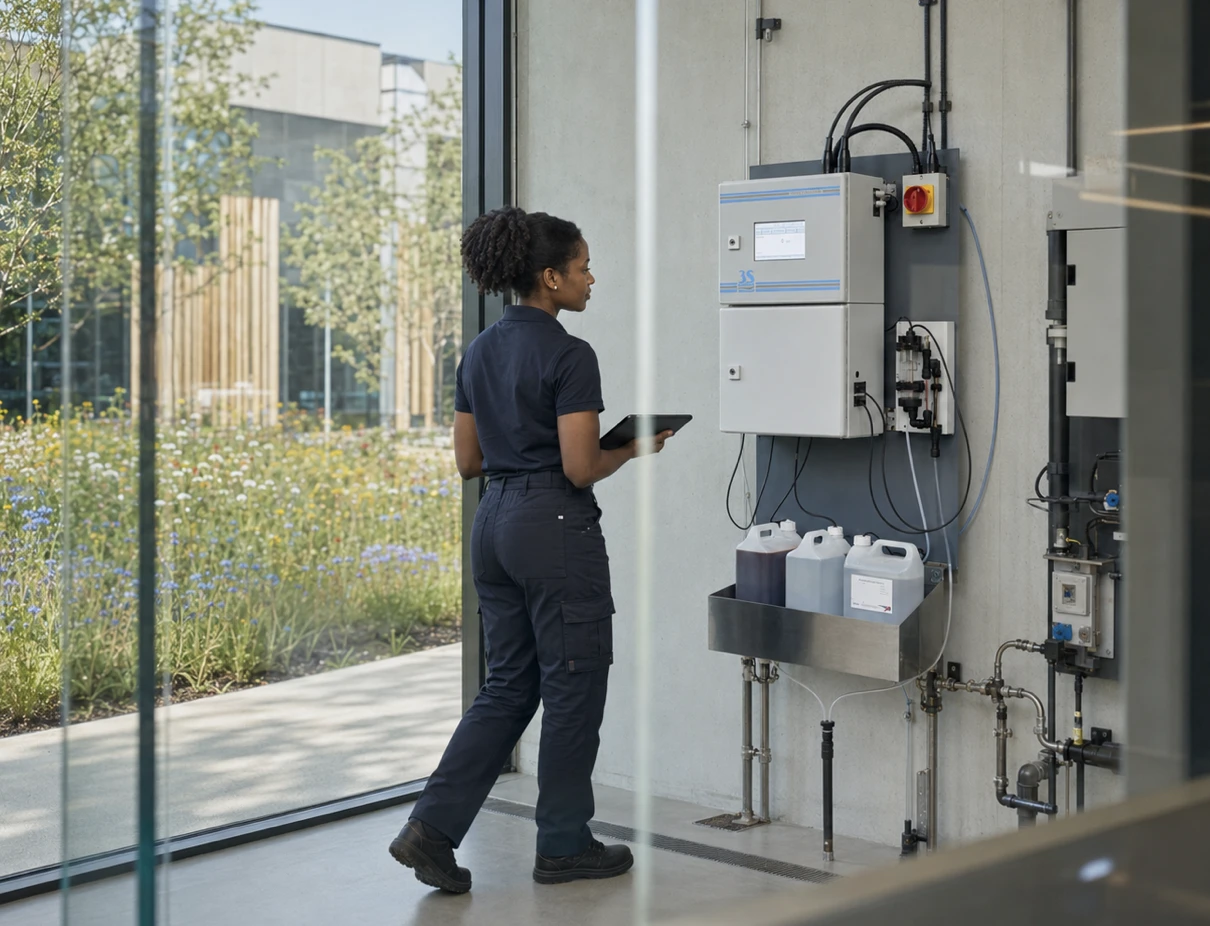
Many important water-quality measurements cannot be made reliably by simply placing a direct sensor into the process. For parameters that depend on controlled chemical reactions, online colorimetry provides another approach: automate the wet-chemistry method inside an analyser and carry out the same sequence repeatedly at the treatment site. The 3S online colorimetric analyser is designed around this principle. Instead of asking an operator to collect a sample, add reagents, wait for a reaction to develop and then read the result manually, the analyser performs the programmed sequence automatically and records the completed measurement.
What is colorimetric water analysis?
Colorimetric analysis measures a substance by creating a controlled colour response. Reagents are added to the sample so that the target analyte produces a measurable optical change. The analyser then measures how much light is absorbed at the wavelength selected for that analytical method.
The important point is that colorimetry is not one universal chemistry. Aluminium, ammonia and ammonium, chlorine, iron, manganese, phosphate and sulphate require different reagents, reaction conditions, wavelengths and calibration ranges. A configurable wet-chemistry platform keeps the analyser architecture consistent while the analytical method is selected around the required measurement.
This is also why users should be cautious with broad specifications. Analysis time, reagent consumption, measuring range and performance can vary from one chemistry to another. The correct parameter datasheet and application conditions should always be checked before an analyser is specified.
Step 1: measure the untreated sample
A typical 3S colorimetric cycle begins with the sample before the colour-forming reagents have been added. This initial reading provides a reference measurement.
Real water samples are not always optically clean. Natural colour, treatment chemicals, fine solids or the process itself may give the sample an existing optical response. Measuring the untreated sample first allows the analyser to take that starting condition into account before the analytical reaction is evaluated.
This reference stage is an important part of differential colorimetric measurement because the final result is not based only on the absolute colour seen after reagent addition. The analyser can compare the optical condition before and after the programmed chemistry has taken place.
Step 2: add the parameter-specific reagents
The analyser then introduces the reagents required by the selected analytical method. PMA reagent manufacturing is relevant here because online colorimetry depends on controlled and repeatable chemistry, not simply on the electronics inside the instrument.
Different parameters use different reactions. The dedicated 3S aluminium method, for example, uses pyrocatechol violet to form a coloured compound with aluminium under buffered conditions. The ammonium configuration uses a different reaction that forms a blue-coloured compound, while the online sulphate analyser method uses an adapted turbidimetric reaction in which sulphate is precipitated as barium sulphate.
Those examples show why the wet chemistry has to be treated as part of the measurement system. Reagent formulation, dosing, reaction conditions and the selected wavelength all contribute to the final analytical result.
Step 3: allow the chemistry to develop
After reagent addition, the analyser follows the programmed sequence required for that method. Depending on the chemistry, this may include mixing, waiting, temperature control, additional reagent additions or rinsing stages.
There is therefore no single analysis time that applies to every 3S parameter. General 3S-CL documentation describes parameter-dependent analysis, while individual parameter datasheets specify the cycle required by their particular chemistry. For a site considering online analysis, response time should be discussed in the context of the actual parameter and process objective rather than treated as a generic platform figure.
Step 4: measure the optical response
Once the reaction has reached the required stage, the analyser measures the developed colour or turbidity at the appropriate wavelength. The optical system uses the resulting absorbance information together with the stored calibration to calculate the reported concentration.
The result may be displayed in units such as ppb, ppm, micrograms per litre or milligrams per litre depending on the configured method. The colour touchscreen presents the measurement and analyser status, while the integrated datalogger can retain results and other analyser information for later review.
Why calibration matters in an online colorimetric analyser
The analyser needs a defined relationship between optical response and concentration. Calibration establishes that relationship using known standards.
The 3S-CL supports programmable automatic calibration. The exact routine depends on the configured analytical method, but the purpose is the same: maintain the relationship between the optical measurement and the concentration reported by the analyser.
Automatic calibration should not be confused with a maintenance-free instrument. It reduces repetitive operator tasks, but the analyser still needs suitable sample handling, correct reagents, periodic inspection and planned service.
What automatic validation adds
Validation is a separate routine intended to check analyser response. Where calibration establishes or adjusts the analytical relationship, validation can provide an additional programmed check that the analyser is responding as expected.
On the 3S platform, validation can be scheduled at selectable intervals alongside automatic calibration and cleaning. This creates a more structured operating routine than relying solely on occasional manual checks initiated after a problem is suspected.
Why cleaning is part of wet-chemistry measurement
Online wet-chemistry analysers handle real water samples, reagents and reaction products. Over time, deposits or contamination can affect the hydraulic and measurement system if they are not managed.
The 3S includes programmable automatic cleaning routines. The appropriate frequency depends on the parameter, sample condition and installation. A relatively clean treated-water sample may behave very differently from a more challenging raw-water or wastewater stream.
Where suspended solids need additional control, the wider 3S installation can also include sample-conditioning equipment. The 3S applications page explains the types of water and process duties that should be considered during specification.
Online colorimetry versus manual laboratory-style testing
The main advantage of moving a suitable wet-chemistry method online is frequency and repeatability. A manual test requires an operator to collect the sample, prepare the test, add the chemistry, observe the timing, record the result and repeat the process later. An online analyser can carry out the programmed cycle repeatedly without requiring every measurement to be performed by hand.
That does not mean online colorimetry replaces accredited laboratory analysis or statutory sampling. Laboratory testing remains essential where it is required for regulatory, reference or quality-assurance purposes. Online analysis instead provides more frequent process information between those manual or laboratory checks.
Where online colorimetric analysis can be used
The 3S platform can be configured for applications across drinking-water treatment, surface and raw water, municipal and industrial wastewater, boiler and cooling water, and industrial process streams. Suitability depends on the parameter, concentration range, sample matrix, measurement frequency and sample-conditioning requirements.
For drinking-water treatment, promoted parameters include aluminium, ammonium, chlorine, iron, manganese and phosphate. Boiler and high-purity water applications can involve chloride, hardness, hydrazine, nitrite, silica and sodium. Industrial applications may require other parameter-specific methods.
The value of being able to see the chemistry
One of the practical strengths of the 3S design is that the wet section is accessible. The sample pump, reagent pumps, measuring cell, tubing, valves and other hydraulic components can be inspected rather than being completely hidden inside a sealed analytical module.
For operators and service engineers, this makes it easier to connect what appears on the touchscreen with the components actually carrying out the measurement. It can also make routine inspection and troubleshooting more understandable.
Choosing the right online colorimetric method
The starting point should always be the application, not simply the analyser model. Before selecting a chemistry, PMA will normally need to understand the parameter, expected normal concentration, minimum and maximum range, sample type, temperature, suspended solids, required analysis frequency, number of sample streams and the reason the measurement is needed.
That application-led approach helps avoid forcing one generic specification onto very different water streams. PMA works with UK customers across water and process instrumentation, and PMA service and calibration support is available for installed instrumentation as part of the wider support offering.
Frequently asked questions about online colorimetry
Is colorimetric analysis continuous?
Most online colorimetric analysers operate in programmed batch cycles rather than making a truly continuous direct-sensor measurement. The cycle time depends on the analytical chemistry.
Does every parameter use the same wavelength?
No. The measurement wavelength is selected for the colour or optical response produced by the specific analytical method.
Can natural colour in the sample affect the result?
Sample colour is one reason a reference measurement is taken before reagent addition. The analyser can compare the initial optical condition with the final developed response.
Does an online colorimetric analyser need reagents?
Yes. Reagents are fundamental to the chemistry. Consumption depends on the selected parameter, method and analysis frequency.
Does automatic calibration remove the need for servicing?
No. Automatic calibration, validation and cleaning reduce repetitive manual routines, but planned inspection, maintenance and correct reagent handling are still required.
Can one 3S analyser measure more than one sample?
The general 3S-CL platform supports two measurable sample streams. Selected configurations can also support additional sequencing or compatible dual-parameter arrangements, subject to application review.
Discuss a 3S water-analysis application with PMA
If you are considering automated wet-chemistry measurement, contact the PMA 3S team with the parameter, expected concentration range and sample conditions. PMA can review the application and help identify whether a 3S configuration is appropriate.