
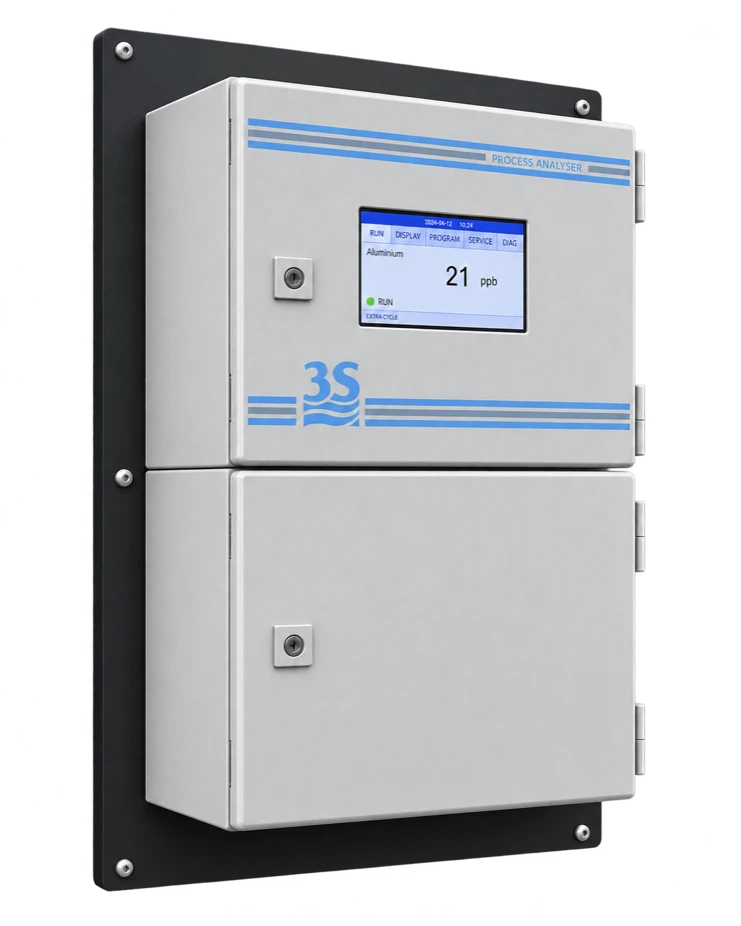
3S Online Colorimetric Analyser for Water
The 3S online colorimetric analyser features parameter-specific wet-chemistry methods, automatic calibration, validation and cleaning, and clear touchscreen operation. Use the online analyser selection guide, plan sample conditioning, and review the current 3S technical resources before final specification.
Repeatable online wet chemistry in a compact analyser
The programmed sequence handles the sample and reagents automatically, allowing operators to review the result and analyser status through the integrated touchscreen.
01 / PROGRAMMED ANALYSIS
Parameter-specific colorimetric measurement
The 3S runs a configured wet-chemistry sequence for the selected parameter, range and sample conditions.
- Programmable analysis frequency
- Automatic result calculation
- Low reagent consumption
02 / AUTOMATIC ROUTINES
Calibration, validation and cleaning
Automatic routines can be scheduled at selectable intervals to support consistent operation between planned maintenance visits.
- Automatic calibration
- Automatic validation
- Automatic cleaning
Core analyser information
General specifications vary with the selected chemistry and should be confirmed against the relevant parameter datasheet.
Flexible mounting
The cabinet supports vertical wall or rack mounting using fixing hinges.
Operating humidity
Designed for working conditions up to 85% relative humidity.
Expandable stream selection
An optional external sequencer can extend the standard single- or dual-stream setup to three streams.
Explore two-stream online water monitoring to see when comparing two sample locations can answer the operational question.
Thirty-day result history
The integrated datalogger can retain up to 30 calendar days of results for daily CSV export by USB.
A controlled analytical sequence
The 3S completes each stage using the configured parameter chemistry and stored calibration.
01.
Measure the reference
The untreated sample is measured first so inherent sample colour can be considered.
02.
Add the reagents
The programmed sequence introduces the reagents required for the selected method.
03.
Develop the chemistry
The reaction is mixed and allowed to develop under controlled conditions.
04.
Measure and report
The optical response is converted into concentration using the stored calibration.
05.
Validate
A programmed validation routine can check analyser response at selected intervals.
06.
Clean
Automatic cleaning supports the measurement system between planned maintenance visits.
One compact analyser. Broad water-analysis capability.
Review the core platform features, application overview, dedicated guidance for drinking water, wastewater nutrients, boiler and high-purity water and industrial process water. Then explore the parameter range or contact PMA to discuss your sample and measuring range. For a cooling-water chemistry brief, see Cooling-Water Monitoring Questions.
Features
- Dual-stream capability
- Colour touchscreen interface
- Programmable batch-analysis frequency
- Heated reaction cell
- Separate wet and electronics compartments
- Compact dimensions
- Low reagent-level alarm
- Automatic calibration, validation and cleaning
- Separate waste line for reagent-bearing sample
- Long autonomy and low routine maintenance
- Robust construction
- Straightforward installation
Applications
- Wastewater treatment plants
- Industrial water applications
- Surface-water monitoring
- Ultrapure water
- Steam and condensate
- Reverse-osmosis plants
- Ion-exchange systems
- Boiler-feed water
- Demineralisation systems
- Process control
- Wastewater process optimisation
- Activated-sludge basin monitoring
- Treatment-plant outlet monitoring
- Drinking-water analysis
- Industrial water-treatment monitoring
Parameters
- Aluminium
- Ammonium / ammonia
- Chloride
- Chlorine
- Chromium(VI)
- Copper
- Formaldehyde
- Hardness
- Hydrazine
- Iron
- Manganese
- Nickel
- Nitrite
- Phenol
- Phosphate
- Silica
- Sulphate
- Zinc
The available measuring range and method depend on the selected chemistry and sample conditions. Confirm the required configuration with PMA before specification.
Designed for practical operation
The 3S separates its electronic and wet compartments while keeping measured values, status and configuration accessible through the colour touchscreen.
Touchscreen
Clear access to measurements, status and analyser functions.
Data logging
Integrated storage with USB export.
Separate compartments
Electronic and wet sections are physically separated.
Low reagent use
Small reagent volumes help control consumable costs.

Built for routine water and process analysis
01
Automatic calibration
Programmable routines reduce the need to initiate every routine calibration manually.
02
Automatic validation
Validation can be scheduled to provide a regular check of analyser response.
03
Automatic cleaning
Programmed cleaning supports the measurement system between planned visits.
04
Colour touchscreen
Measured values, status and configuration are presented through the integrated display.
05
Low reagent consumption
Small reagent volumes help control ongoing consumable cost.
06
Programmable analysis
Analysis frequency and method can be configured around the selected chemistry.
07
Integrated datalogging
Results, calibration information and alarms can be retained and exported.
08
Dual-stream capability
The general platform supports two measurable samples.
09
Separate compartments
Electronic and wet sections are separated for practical access and service.
Technical specifications
Core 3S-CL information for specification and application review.
| Measurement principle | Spectroscopic colour-development reactions |
| Variables | Parameter dependent; approved method |
| Analysis frequency | Approximately 6 to 20 minutes |
| Power supply | 110-230 VAC, 50/60 Hz, 80 VA |
| Operating temperature | 5 to 45°C |
| Cabinet | Epoxy-coated stainless steel |
| Protection grade | IP54 |
| Outputs | 2 x 4-20 mA; Modbus according to configuration |
| Automatic functions | Calibration, validation and cleaning |
Specifications should be confirmed against the latest 3S product and parameter documentation before procurement.
Where the 3S can be used
The correct configuration depends on the parameter, concentration range, sample condition and analytical method.
Drinking-water treatment
Online measurement of selected metals, nutrients and treatment residuals across suitable treatment stages.
Wastewater
Selected municipal and industrial wastewater measurements where the chemistry and sample conditioning are appropriate.
Boiler, cooling and process water
Configurable wet-chemistry measurement for suitable industrial and high-purity-water applications.
Online measurement does not replace required laboratory analysis
Accredited laboratory analysis and statutory sampling remain necessary where required by the application or regulation.
What is online colorimetric analysis?
Colorimetric analysis measures a controlled colour response produced by parameter-specific chemistry and relates the optical response to concentration.
What does the reference measurement do?
The untreated sample is measured first so the analyser can compensate for optical effects already present in the water.
What happens during colour development?
The required reagents are introduced and the programmed reaction develops before the final optical measurement.
Why does the correct chemistry matter?
Each parameter requires the correct reagents, wavelength, reaction conditions and measuring range.