

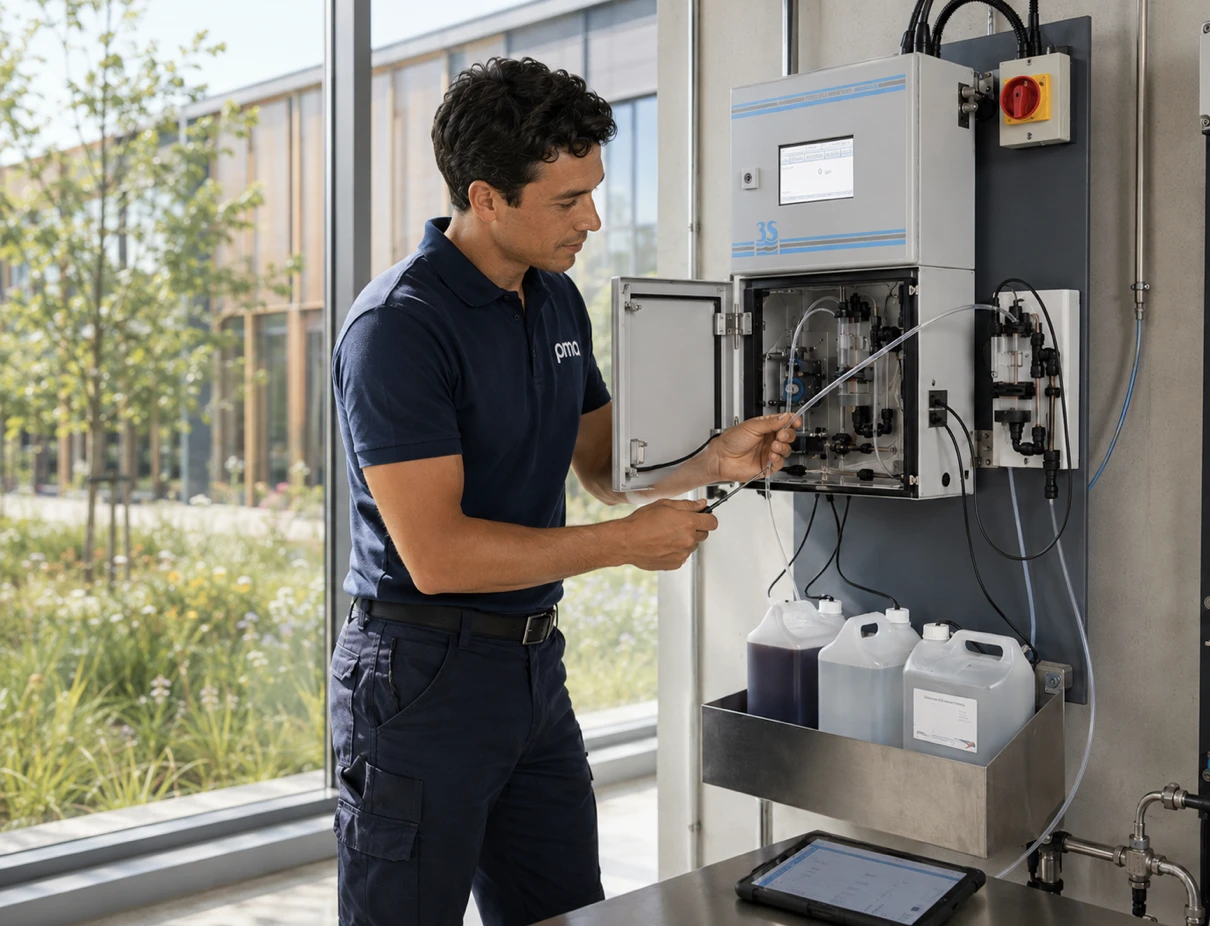
A colorimetric analyser automates sampling, reagent addition, reaction timing and optical measurement, but the analytical system still needs planned consumables and maintenance. The useful question is not whether maintenance can be eliminated; it is how the site will recognise changing conditions and complete the right work before results are disrupted.
Begin with the configured method
Reagent quantities, preparation, stability and consumption depend on the parameter, method, measuring range, analysis frequency and any automatic calibration, validation or cleaning routines. A generic consumption figure should not be copied into a project budget without the actual configuration.
Build a reagent plan
- Confirm every reagent, cleaning solution and calibration standard required by the installed method.
- Record preparation instructions, batch or expiry information and the mixed-on date where applicable.
- Set stock levels around delivery time, analysis frequency and site access.
- Store unused reagents under the conditions stated in their instructions; the PMA training notes advise cool storage and flag hot kiosks as unsuitable for reserve reagent storage.
- Inspect bottle levels and ensure feed lines remain primed without air leaks.
- Use the analyser’s reagent-level warning as an operational aid, not as the only stock-control process.
Use automatic routines deliberately
The 3S-CL provides programmable automatic calibration, validation and cleaning. Their intervals should reflect the chemistry, sample and operating experience. More frequent routines can consume more reagent and standard, while intervals that are too long may fail to identify drift or fouling soon enough. See the guide to automatic analyser routines.
Plan routine inspection
The core brochure states a typical maintenance frequency of every four months, while noting that some parameters or samples require more maintenance. Treat this as a platform starting point, not a universal promise. Dirty samples, harsh environments or chemistry-specific components may justify a different schedule.
- Check current analyser status and active alarms.
- Review recent results and events for changes in behaviour.
- Review the last calibration and validation information.
- Check sample flow, reservoir condition and drain.
- Inspect reagent bottles, tubing, connections and pump operation.
- Inspect the reaction vessel or cell and any sample-conditioning equipment.
- Record work completed, parts used and the next planned action.
Investigate unexpected results systematically
Confirm that the analyser is online, the displayed result is current and no alarm is active. Check the sample and reagent paths before adjusting method settings. Comparing the next complete analysis cycle, calibration history and a properly aligned manual sample is more useful than reacting to one isolated value.
Information that improves support
When contacting PMA, provide the analyser serial or identifying details, configured parameter, current status, alarms, recent result pattern, calibration information, reagent dates, sample conditions and clear photographs where useful.
For installed-instrument help, visit 3S product support. For a new application, use the 3S enquiry form.