


Orthophosphate and total phosphorus begin with different questions
Phosphorus monitoring is often discussed as though one number can answer every treatment, reporting and environmental question. In practice, the first decision is more basic: what form of phosphorus does the site need to understand, and why?
Orthophosphate and total phosphorus are different determinations. The Environment Agency’s current water-monitoring method guidance lists them separately and identifies digestion as part of the total-phosphorus method route. That distinction matters when a monitoring brief is being written, when results are compared and when a treatment team is deciding what action a trend should inform.
For wastewater sites in England, this is not an abstract issue. The Environment Agency’s wastewater treatment-monitoring guidance identifies phosphorus and nitrogen monitoring where relevant, and makes clear that compliance sampling, locations and limits are set through the applicable regulatory and permit framework. Online instrumentation can provide timely operational information, but it does not replace the permit-defined sampling and laboratory arrangements.
The useful starting point is therefore not “which analyser is best?” It is: “Which result will answer the decision we need to make?” The answer should be agreed by the process, laboratory, environmental and engineering stakeholders before a method, sample conditioning arrangement or online analyser configuration is selected.
What orthophosphate tells you
Orthophosphate is a defined phosphorus determination. It is commonly relevant where the immediately measurable phosphate fraction is the operational focus. It can be useful for following a treatment-stage response, comparing a process trend against a site’s own operational expectations, or understanding how a particular point in the treatment train is behaving.
That does not make it a substitute for total phosphorus. A result can only be interpreted against the method, sample point, treatment stage and reporting basis that produced it. A useful specification should state the reporting convention explicitly, for example whether the target result is expressed as phosphorus, and should not assume that readers will infer this from a generic label such as “phosphate”.
The Environment Agency’s monitoring-method guidance distinguishes orthophosphate from total phosphorus and records different method pathways. That is a practical reminder to keep the analyser requirement, laboratory comparison method and internal reporting labels aligned.
What total phosphorus tells you
Total phosphorus is the broader determination. The current 3S total-phosphorus page explains that the required preparation and measurement sequence must be configured for the application, and that sample treatment may be required. It should therefore be specified as a total-phosphorus requirement, not assumed from an orthophosphate request.
For a wastewater project, ask whether the intended decision concerns total phosphorus at a process or final-effluent point, a treatment-stage trend, a performance investigation, or a permit-related result. The answer affects the method review, the sample presentation and how the online value is compared with other results.
The regulatory context is also site-specific. The Environment Agency explains that relevant wastewater-treatment works can have phosphorus monitoring and limits, while the national wastewater target programme is driving further phosphorus-reduction work. Neither fact establishes a universal limit for a particular works. The permit remains the authoritative source for that site.
Why the sample point matters as much as the chemistry
An analyser can only report on the sample delivered to it. The Environment Agency requires permit sampling points to be representative of the discharge or influent they are intended to characterise, and notes that wastewater samples may be taken as 24-hour composites for compliance purposes. That framework should not be copied uncritically into an online installation, but it underlines the engineering question: does the chosen take-off represent the water and the decision being monitored?
Document the intended sample point, whether it is before or after a treatment stage, its hydraulic conditions, temperature, solids loading, pressure and likely sources of variation. If the comparison is to a laboratory result, also document the laboratory sample point, sample preparation, method and timing. A mismatch may be a comparison problem rather than an analyser problem.
For online wet-chemistry systems, suspended material, colour and matrix chemistry can all affect the application review. The 3S wastewater nutrient-analysis page is the appropriate internal starting point for the application context; the total-phosphorus analyser page is the destination for the configured total-phosphorus measurement discussion.
Turn the monitoring objective into a clear specification
Before requesting a proposal, write a short measurement brief that answers these questions:
- Which determination is required: orthophosphate, total phosphorus, or another explicitly defined result?
- What units and reporting basis are required, and who has agreed them?
- Where is the sample taken relative to treatment stages, returns and final discharge?
- What are the expected concentration range, solids loading, colour, temperature, pressure and flow conditions?
- Is the online result for operational trending, investigation, treatment control support, reporting support, or another defined purpose?
- How will routine checks, calibration, validation, cleaning, maintenance and laboratory comparisons be managed?
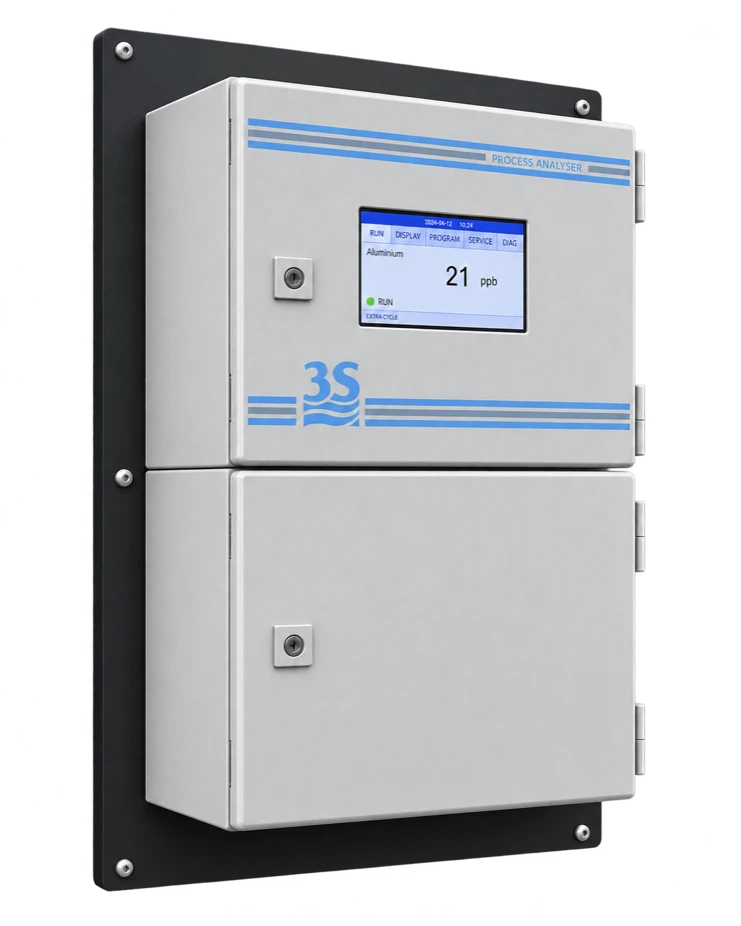
The 3S-CL platform is designed for configured, reagent-based colourimetric water analysis. Its supplied brochure describes automated calibration, validation and cleaning functions, with the final method and sample arrangement dependent on the parameter and application. It should not be described as a generic compliance instrument without a site-specific review of the method and regulatory requirement.
Use online data as part of a defensible monitoring plan
Online results are most useful when the team has agreed how they will be used. That can include trend review, defined alarm investigation, checking a process response or identifying when a confirmatory sample is needed. A number without an agreed response can create noise rather than useful operational insight.
Set out who reviews results, which conditions trigger investigation, how the result will be checked and where the evidence will be recorded. Keep online operational data separate from statutory reporting unless the relevant method, equipment, sampling arrangement and approval route have been confirmed for that purpose.
PMA’s online colorimetric analyser information provides the wider parent-site context, while the dedicated 3S site should remain the detailed resource for the configured application. PMA states that it has over 50 years’ experience supplying, supporting and troubleshooting process analysers. That experience is useful when turning a broad monitoring objective into a practical, evidence-led application review.
Contact PMA about a phosphorus-monitoring application
If you are planning phosphorus monitoring, share the required determination, sample point, expected range, solids and colour, treatment stage, reporting basis and the operational question the result must answer. PMA can then review whether a configured 3S application and sample-conditioning approach are appropriate. Contact PMA to begin the discussion; the permanent enquiry form can capture the site details below this article.
Frequently asked questions
Is orthophosphate the same as total phosphorus?
No. They are separate determinations in the Environment Agency’s monitoring-method guidance. Total-phosphorus methods include a digestion route; select the determination that matches the defined monitoring question.
Can an online phosphorus analyser replace compliance sampling?
Not by assumption. Compliance requirements, sample points, methods and reporting arrangements are site- and permit-specific. Online results can support operations, but the applicable permit and regulator guidance determine compliance monitoring.
Why should the reporting basis be written into the specification?
Phosphorus results can be labelled and expressed in different ways. Stating the required determination, units and reporting basis avoids comparing unlike results or configuring the wrong method.
What information should be supplied for an application review?
Provide the required determination, expected range, sample point, solids and colour, temperature, pressure, treatment objective, required analysis frequency and how the result will be used.