
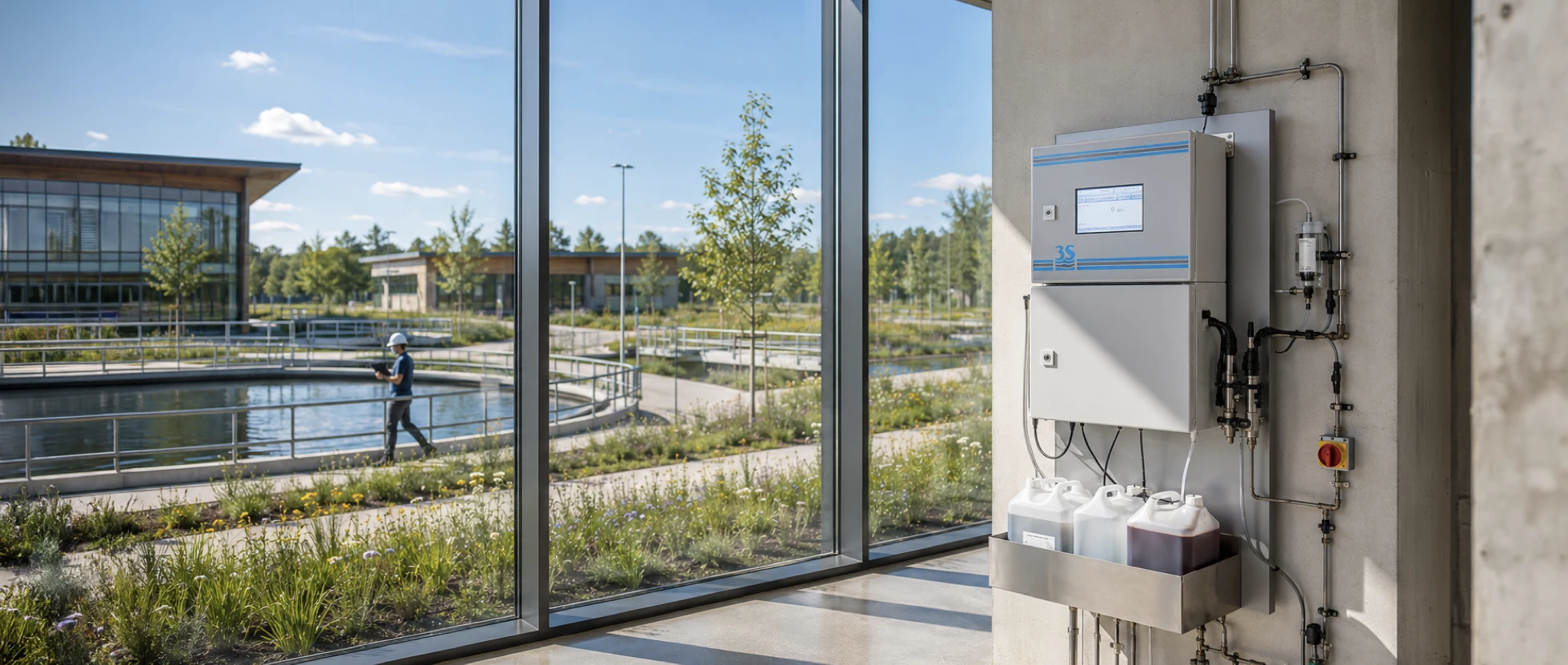
Online Nitrate Monitoring for Drinking Water
Nitrate can change long before a single final-water result explains why. A useful online monitoring plan starts with the source, the treatment route and the decision an operator must make when a trend moves. PMA can review the sample, target result and suitable 3S-CL configuration for that duty.
Follow nitrate from source to treatment
Nitrate in drinking water is often linked to diffuse agricultural pollution. The Drinking Water Inspectorate notes that it can persist in groundwater and affect surface water after rainfall and runoff. The monitoring question is therefore broader than “what is the nitrate value now?” Teams may need to understand whether a change began at an abstraction point, followed a blend or appeared after a treatment decision.
For practical planning guidance, read Nitrate Monitoring Across Blended Sources.
Online results can add operational context between scheduled samples. They must be interpreted alongside the site’s risk assessment, laboratory programme and the actual water route. The intended nitrate result and reporting units should be written into the brief before comparing data from different sources.

Where repeated results can help
Source-water trends
Identify which borehole, intake or raw-water line represents the risk being investigated. Record seasonal behaviour, blend changes and the delay between the source and the analyser. A sample point that misses a changing source cannot answer the catchment question.
Blending and treatment decisions
If blending or treatment is part of the control strategy, place the measurement where its trend can be related to that action. Define what a rising result would trigger and which other measurements or operating records must be reviewed with it.
Verification and response
Agree how online results will be checked against an appropriate manual or laboratory method. Record the sample point, time, preparation, nitrate reporting basis and response procedure so a difference can be investigated rather than guessed at.
How a configured 3S measurement fits
The current 3S-CL brochure lists nitrate among its available colorimetric parameters and potable and surface water among its application types.
The analyser automates a parameter-specific reagent sequence and records results for operational review. The approved nitrate chemistry, measuring range and installation arrangement depend on the sample and must be confirmed during application review.
Define the nitrate duty
Tell PMA the source, target measurement and units, expected normal and upset concentrations, sample colour and solids, temperature, pressure, flow, proposed take-off point and how the result will be used. Nitrate and nitrite are distinct measurements; one must not be assumed from the other.
Keep the regulatory question clear
The DWI reports a prescribed nitrate concentration value of 50 mg/L as nitrate at consumers’ taps and expects water companies to manage risks through catchment management, blending, treatment, operational monitoring and contingency arrangements where required. Those requirements are context for a site’s monitoring strategy. A 3S online trend does not by itself replace statutory sampling, an approved laboratory method or the site’s documented response plan..
Continue your research
Review the related parameter and application pages before discussing your sample with PMA. Also see Sample Conditioning.
Discuss Your Nitrate Monitoring Application
Share the source-water and treatment context, expected range and proposed sample point. PMA can review whether a 3S nitrate configuration and sample arrangement suit the operational question.